Sunday, July 09, 2006

Will Microsoft Sing ?

It is going to be a multi billion dollar question, witnessing the success story of Apple's iPod and iTunes. Now Microsoft is speculated to launch its own digital music player around Christmas this year. It will also reportedly carry wireless technology enabling users to download music without linking to a computer. In the past Microsoft has worked with iRiver to create Clix where it provided the underlying software. Microsoft has already introduced other initiatives to compete with Apple's iTunes music service. In May it launched along with MTV Networks the Urge music store as part of the Windows Media Player 11 public beta. The Urge store allows users to purchase songs for $1 and albums for $10, as well as to buy a $15 monthly subscription. The service is not compatible with Apple Macs or iPods. There have been several signs that the world's largest software maker might be planning a music device. The company recently jumped into cell phones with Windows Mobile, and more recently it announced that it was collaborating with France's Bouygues Telecom to launch a new mobile music service in 2007.

If Microsoft plunges ahead with this new approach, the software maker will be in a tricky situation. Because of Apple's leadership position (74% market share), Microsoft needs to drop its current strategy of embracing Apple's solo approach, where songs purchased at Apple's iTunes online music store will only work on its iPods. Songs purchased from Microsoft's new, improved online music service will also likely play on devices made by longtime hardware partners such as Samsung, Creative Technologies, and iRiver.

Better Strategy for Microsoft would be to go for seamless compatibility between player and its hit product Xbox gaming console, giving the flexibility to play stripped down versions of games on its player but in the first version chances are bleak as Microsoft might not be ready with the games for its digital ecosystem. Microsoft's IPTV would be the next one to be integrated to prevent Apple's entry into homes with digital platform for living rooms. However this strategy would be a threat to MS's partners like iRiver and MTV in the digital music space, Microsoft needs to very well execute the plan to rerun the success story of Apple as owning everything doesn't guarantee the success as evident from Sony's fate. Sony owned content, devices, software and an online store and it hasn't enjoyed nearly the success Apple has. What is going to happen with Microsoft will be interesting in its own terms so till then keep your fingers crossed.

Little City preparing for Big IPTV fight

The Little Rock city will soon be witnessing the full-blown competition between Comcast and AT&T as the latter has applied for the franchise agreement. This will see some regulatory hurdles too like "Right of Way" and social services like emergency broadcasting. Main reason behind this is the cherry-picking policy of AT&T. AT&T plans to provide this service to 90 percent of the high value customers, 70 percent of the medium value customers, and just five percent of the low value customers. In case they won't be able to offer emergency broadcast to entire city which is being followed by Comcast Cable.

In a nod to the cable companies’ often-heard complaint that AT&T doesn’t plan to offer the same service to everyone when it comes to IPTV, the agreement goes on to say that AT&T “intends to” offer video service to anyone residing in Little Rock, regardless of income or minority status. In the case of those living more than several hundred yards from an IPTV node, the service offered would be a satellite-based AT&T product called Homezone. Currently, it is technologically impossible to offer PEG channels (city's public, educational and government programming) and local emergency broadcast features over satellite-based television.


In the proposed agreement, AT&T promises to:

• Provide “some form of access” to the city’s public, educational and government (PEG) programming — probably via broadband Internet broadcasts in the short term.

• Pay the city 5 percent of the gross revenue collected for IPTV services.

• Pay the city an additional 10 cents per month per subscriber once PEG channel go online

• Provide an apparatus for alerting IPTV viewers to a public safety emergency “as soon as it is technically feasible to do so.”

Both AT&T and Comcast cable have mounted an extensive lobbying campaign for the coming July 11th meeting. AT&T is banking on "giving choice to consumers" while Comcast is relying on the differential treatment to city people by AT&T. Once AT&T gets this agreement signed, the field will be open to fight for next 3 years.

Who Killed Set Top Boxes ?

Verimatrix is in the process of building a PC application that will allow IPTV customers to watch all of their TV channels from any broadband-connected PC in the home. The software app, code-named "Secure PC Player," will help carriers convince content makers that it is possible to create a media player for the PC that keeps content every bit as secure as a set-top box. Verimatrix system includes a session-based watermarking method that leaves a digital fingerprint on each content stream entering a PC. That way, if the content later shows up on the Internet or somewhere else it shouldn't be, the service provider could conceivably trace the content back to an individual customer.

This technology, which Verimatrix calls "VideoMark," has already been deployed in India in Mahanagar Telephone Nigam Ltd. (MTNL) 's IPTV service, but that deployment was tethered to a set-top installation. As Verimatrix tinkers with the project, it is working on both a "lean forward" interface (one more suitable for use at a PC) and a "lean back" interface (one more suitable for a home media center PC that is operated via remote control from the couch). In homes that already have media center PCs as part of the entertainment center, this kind of technology could eliminate the need for a set-top box altogether. this technology can definitely allow carriers to offer a direct alternative to Sling Media Inc. 's Slingbox, with no additional hardware required.

IPTV Update Plus

STB Killer by Verimatrix

Verimatrix is building a PC application that will enable IPTV customers to watch all of their TV channels from any broadband-connected PC in the home. The software application is code-named "Secure PC Player" and will, reportedly, help carriers convince content makers that their content can be just as safe on the PC as in a set-top box. One feature of Verimatrix's offering is a watermark method that leaves a digital fingerprint one each content stream entering the PC, so if the content shows up elsewhere the service provider could trace it back to an individual user.
Full Story


BNS & PTC to supply H.264 equipments to Vietnam

Broadband Network Systems Ltd, together with partner PTC Ltd, has secured a ground breaking deal to provide H.264 SD live encoders and decoders to Vietnam to enable the first broadcast quality video transportation in the country. The Envivio H.264 SD live encoders and decoders will be used for the commercial launch of broadcast quality video transport from Hanoi to Ho Chi Minh City by an undisclosed top Vietnamese telco.
Full Story


TiVo case study by Research & Markets

Research & Markets has announced the addition of Can TiVo Survive? A Case Study in the Perils of First-to-Market Innovations to their offering. The report examines a variety of DVR and digital media subjects, including (1) the unique evolution of TiVo as a company and technology purveyor; (2) the competitive environment in which TiVo now finds itself; (3) profiles of relevant competitors; and (4) the viability and likelihood of partnerships with Google, Yahoo, Apple, Sony, and online content purveyors such as MovieLink and CinemaNow.
Full Story


Go ahead for internet television in Netherlands

In May, the Netherlands’ largest carrier KPN (The Hague) launched Mine, its IP controlled TV service, available on domestic television sets via a broadband connection and set-top box. KPN’s customers can call up programs from the three public Dutch channels as long as ten days after they have been broadcast. They can also record up to 100 hours of programs on a recorder supplied via the operating network, and select broadcasts from 65 TV and 60 radio channels using an electronic program guide. KPN also plans to include special interactive programs in its IPTV service. For example, the country’s three largest football teams – Ajax, Feyenoord and PSV – will be providing their own TV channel.
Full Story

Weekly IPTV Update

Animo's STB in N. europe's first HDTV service

Set-top boxes (STB) from UK manufacturer Animo have been used in northern Europe's first ever high definition IPTV service. The service was rolled-out in time for World Cup football matches offering viewers greater clarity and detail. By selecting Amino for this deployment, Lijbrandt Telecom BV was able to deploy HD services rapidly. As well as HDTV, the service will also offer triple-play functions; the grouping together of internet access, TV and telephone services into one subscription via a broadband connection. Lijbrandt, the firm being the new service, expects it to attract 120,000 subscribers within three years.
Full Story

Verizon sues over IPTV

While Congress dithers over a telecom reform bill that may or may not pass this year, Verizon is moving to the courts to prove its point that a national video franchising law is necessary. Both the Senate and the House are pushing legislation to allow Verizon and AT&T to bypass local franchising authorities in rolling out their Internet Protocol TV (IPTV) offerings. The idea is to streamline the entry into the pay television market to bring another competitor to cable systems.
Full Story

Regulatory hurdles worry IPTV industry

Regulations and customer understanding are the two biggest barriers to the success of IPTV (Internet Protocol television), say operators, content providers and vendors that participated in a survey done by the Economist Intelligence Unit Ltd. and Accenture Ltd. Standardization issues and marketing and pricing also ranked high among areas of concern in the IPTV survey.
Full Story

Archer launches Indiatvlive.com

Archer Entertainment Media Communications has launched Indiatvlive.com, reportedly one of the first Indian IPTV platforms to stream Indian TV, radio and internet content. Indiatvlive.com will enable all Indian media via IP to deliver television and radio channels in real time, live from India on wired, Wi-Fi and cellular devices across the world. The content will comprise news, sports and entertainment in all languages of India. Full-time broadcasting via indiatvlive.com and indiaradiolive.com will begin by 15 August 2006 to mark the 59th anniversary of India's independence.

Verimatrix is selected for First Moscow IPTV Deployment

Verimatrix, developer of the most widely deployed IPTV content protection system with tier one operators is going to work with Russian systems integrator CTI to secure the content of Central Telegraph's IPTV service for Moscow and the Moscow region. The service roll-out, which will be made available to Central Telegraph's 60,000 broadband Internet subscribers, will be completed by October 2006. The IPTV service will offer interactive television services such as Video-on-Demand (VOD), premium channels, information and interactive services, as well as traditional broadcast and multicast TV and radio channels.
Full Story

India: IPTV likely to be under Cable TV act

IPTV is slated to be governed under the cable laws, as stakeholders including broadcasters and multi-system operators (MSOs) have sought the Telecom Regulatory Authority of India (Trai) to amend the Cable TV Networks (Regulation) Act, 1995, to this effect. Responding to TraiÂ’s proposal of excluding IPTV from the purview of cable Act, both Zee and Star TV have said the foreign direct investment (FDI) limit of 49% on cable services should also be applicable to IPTV. Currently, IPTV attracts 74% FDI cap with Bharti Airtel and Reliance group holding IPTV licences.
Full Story


ESPN inks IPTV deal

ESPN Classic has reached a carriage deal with Telefónica’s Spanish IPTV platform Imagenio, reaching more than 250,000 subscribers. Imagenio offers 66 different TV channels, 15 radio stations, a pay per view football channel and interactive information and commercial services. The channel reaches 20 million viewers in over 40 countries, including Italy, France, Denmark, Finland, Germany, Belgium, Monaco, Poland, Portugal and Croatia.

TRAI withdraws paper on IPTV

Telecom Regulatory Authority of India (Trai) is set to withdraw a consultation paper on IPTV that it had issued some time back.Though this can be viewed as a small victory for the broadcasting and cable community, which was resisting pressure from telecom companies to take IPTV out of the ambit of Cable TV Networks (Regulation) Act. In its consultation paper, Trai had asked whether itÂ’s feasible to take IPTV out of the purview of the Cable TV Act and have separate licensing norms for it for its growth. The basic intention behind the proposed amendments in the Cable Television (Regulation) Act, 1995 was to keep the IPTV service outside the definition of `cable services.
Full Story

Cable Cos using competitive pricing to fight IPTV roll-outs

San Antonio, Texas is a perfect example of this phenomena. AT&T has recently launched its U-Serve IPTV offering in the city prompting leading cable incumbent, Time Warner, to reduce the cost of its television, internet, and phone services, and offer special bonuses like free premium channels and faster broadband connections to loyal customers.
Full Story

Tamblin launched the interactive portal for IPTV operators

Interactive TV firm Tamblin has launched a service aimed at telecoms operators looking to add further interactive elements, such as games, forums and advertising, to their existing broadband TV services. The IPTV Interactive Portal is powered by TamblinÂ’s i-ZoneTV technology. Tamblin is working with a number IPTV industry players including Microsoft, Ant and Espial, to help ensure portal can deploy quickly to these leading platforms.

Indiatvlive.com to provide indian content over IPTV

The portal has been launched in the US by Archer Entertainment Media Communications. It will also be launching www.indiaradiolive.com, which will begin by 15 August 2006. IndiaTVLive.com will stream Indian TV, radio and internet content to subscribers over IPTV. It will deliver television and radio channels real time, live and direct from India in high definition television quality on wired, Wi-fi and cellular devices worldwide.

Saturday, July 08, 2006

AT&T's New IPTV (Uverse) Channel Guide

Reliance Infocomm: Smart IPTV Strategy

Reliance is venturing in entertainment space in a big way as it is targeting Indian market with multi-pronged strategy. It includes customer reach and content aspect. For urban India Reliance is going with IPTV project termed as "Home Netway" with Alcatel-Microsoft solution and for rural India or areas without its fiber coverage it going with DTH termed as "Bluemagic". It can be a marvelous strategy to reduce CAPEX as well as reaching wider subscriber space. Reliance will not be able to reach all the customers at once because of huge CAPEX requirement due to Metro Ethernet Network (MEN) deployment. Moreover it won't be able to lay fiber at fast speed and meantime customer can be grabbed by MTNL, BSNL and Bharti so it is launching DTH services to expand its reach.

On the content front it is slowly integrating all the entertainment aspects into its own telco strategy. Reliance has already acquired Adlabs and Primefocus for the post-production, distribution and exhibition of movies. On the gaming front it has acquired Paradox Studios for developing gaming content used on mobile and broadband platform. Moreover Adlabs is planning to venture in Home Video segment. Reliance is also in talks with Zee and Sony for content creation and content aggregation.

Reliance is not seeing IPTV / DTH project as stand alone services or bundled services. It is planning for the convergence arena where reliance will be having presence in households with high speed network and will be providing "Smart Home Services" for all Ethernet enabled devices. Company has got CHOISpad (developed by Innomedia Technologies) which can be used to control everything in the home. CHOIS stands for Convergence based Home and Office Interactive Services. CHOISpad is a customized set top box (STB) controlled by CHOISer (remote).

CHOISpad becomes the Prime Mover, for shaping up the requirements of the Netway. Netway fibers have to bring at least a Gigabit of bandwidth near every home/office, so that it can carry almost half a gigabit worth of multicast Digital channels. To keep costs at minimum, it is necessary to provide a conventional 100 Base T, UTP cable connection to every premise. Like the electricity meter, the UTP connection at homes is actually provided through a Secure Gateway. This Secure Gateway can connect to four adjoining user premises using 100 Base-T UTP cables. The simplest way would be to directly connect the UTP cable to a CHOISpad. Practically, however, the connection will terminate on a simple unmanaged switch at the home. The Home Switch will in turn connect to many Ethernet devices via RJ-45 sockets.

Ethernet devices at homes can be PCs, CHOISpads, or any of the Ethernet/Internet appliances. For convenience the RJ-45 sockets for plugging these appliance has to be co-located with the normal electric plug points. For convenience of connecting the RJ-45 sockets in a bussed manner, the Home Switch uses Half-Duplex protocol. Any electrician can now manage even the UTP wiring at homes. This shows that the electrical accessory shops, will now stock Ethernet wiring accessories too. This will spur a commodity market for Ethernet appliances, and white goods which can be remotely configured / interrogated through the internet.

Future of IPTV

IPTV is considered to be the savior of wireline industry but the knights of telecom industry are portraying something else about the future of IPTV especially in the near term i.e. 12 months. Over the next 12 months, most industry players don’t expect IPTV to generate ‘significant’ revenue. However, in three years’ time, confidence in IPTV as a major contributor to the top-line increases markedly.This was one of the key findings of a survey conducted by the EIU (Economist Intelligence Unit) and Accenture during April to May this year.

They interviewed 302 executives in total, representing telecom, broadcasting and media firms but only 4 percent said they were ‘very confident’ that IPTV would generate significant revenue in the coming year. Considering the longer term window, the picture of future drastically changes. In three years’ time, 34 percent of respondents ‘strongly believe’ that IPTV will generate significant revenue, while another 57 percent say that they are at least ‘somewhat confident’ that this will happen. This may be bacuse of problems faced by telcos with regard to IPTV i.e. regulation, standardisation and securing content and it is believed that they would all be resolved within three years.

The top two IPTV services that the survey group believe will offer the ‘most significant opportunities for revenue
growth over the next three years’ are video on demand (19 percent of the vote) and bundled packages (15 percent). Surprises were from the advertising side that only made sixth spot (6 percent) as one of the IPTV services with most revenue potential. So tailored and interactive advertising, which IPTV can provide, is a big opportunity for wireline operators.

But the strategic worth of IPTV should not be measured in revenue growth only. As a mechanism for ‘locking in’
customers and reducing churn, IPTV will also play a valuable role. As Accenture points out in its commentary alongside the survey results, PCCW – Hong Kong’s incumbent – lost ‘tens of thousands’ of landline customers to alternate competitors three years ago. However, thanks to IPTV, PCCW has not only reduced its churn rate by 50% but expects to increase its fixed subscriber base this year. With 549,000 IPTV customers as of April 2006, PCCW has the world’s largest IPTV deployment.

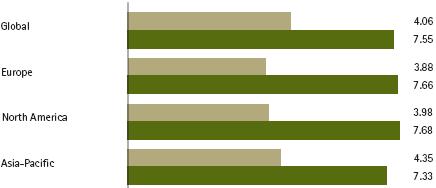
Respondents to the Accenture/EIU survey covered 40 countries in three regions: 35 percent were based in Europe; 33 percent in the Americas; and 32 percent in the Asia- Pacific. Different parts of the IPTV value chain were represented, including: equipment manufacturers (22 percent of the survey group); content providers (14 percent), integrated fixed/wireless telecoms operator (12 percent); TV broadcast network operators (10 percent); and fixed network operator/service providers (9 percent). Collating all the responses from the survey, Accenture/EIU have developed an ‘IPTV confidence index’. At the moment, confidence in IPTV as significant revenue generator in the short tern is measured at 4.06 (a ‘little confident’) on a scale of 1-10. The confidence index rises to 7.55 (‘fairly confident’) when a three-year time frame is considered.


This should come as no surprise. IPTV propels telecoms operators from the familiar territory of selling per-minute or flat-rate voice and data services into a whole new business of managing and pricing content. Breaking into IPTV creates a dilemma for operators: they must keep prices low to lure subscribers, but equally they must secure a return on their investment in infrastructure and content. This will be difficult to achieve in the short term. Survey respondents say that, over the next year, high subscription fees due to the cost of network access and/or equipment will be the greatest obstacle to IPTV adoption by households, along with quality of service issues.These barriers to market growth will diminish over time. Equipment costs will fall, and quality hitches will ease as the technology improves.

Three years from now, IPTV providers will also be bringing substantially more content to customers than today,
mainly through revenue-sharing or distribution agreements with content owners, and some also through content development of their own. But content sourcing will increase costs; indeed, executives in our survey expect the high cost of content to keep subscription prices high, and that in three years this will be an important obstacle to household adoption. By then, the competitive environment will be different. Not only will telcos be vying with alternative operators for IPTV customers, but cable and DTH (direct-to-home satellite) operators can be expected to respond aggressively. Executives in the survey say emphatically that the competitiveness of offers from cable and DTH providers will be the single greatest obstacle to IPTV adoption in three years' time. Here if we can look towards telcos of developing nations we can find the solution. For example ADAE (Anil Dhirubhai Ambani Enterprises) aka Reliance is coming both in the DTH as well as IPTV space. This will help it to reduce the content cost as well as wider reach in the remote areas too. It has acquired Adlabs and Primefocus for the post production, distribution and exhibition of movies.Company is already in talks with Zee and Sony for content creation, aggregation for TV and distribution. So in long term Reliance intends to develop an entertainment strategy. This can be taken as a case study by global telcos to develop strategy for entertainment space.

With competition from cable and DTH space, operators will need to be creative, and no more so than in pricing. In the short term
at least, it is their ability to bundle voice, internet and video/TV services in discounted packages that offers the greatest appeal to customers. Once the flow of content begins, most are certain that video-on-demand will be the most attractive IPTV service to customers, and the paramount revenue generator. Maybe so, but industry experience suggests they should keep their minds open.

Tuesday, July 04, 2006

DoCoMo Unveils Six New FOMA "7 Series" Models


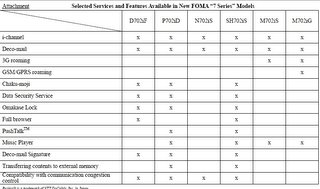
NTT DoCoMo, Inc. and its eight regional subsidiaries today introduced six handsets in the 3G FOMA™ "7 Series." The stylish lineup places special emphasis on design and even includes three models conceived by noted outside designers:

D702iF: Momoko Ikuta
P702iD: Taku Satoh
N702iS: Oki Sato

All the models are compatible with video phone, i-channel™ for news delivered automatically to the phone's standby screen as telop text and Deco-mail™ e-mail decoration. Some are also compatible with international roaming service WORLD WING™ and Chaku-moji™, which lets the caller enter a short message that will appear on the receiver's phone as it rings. Security features of some models include Data Security Service™, which enables phonebook to be stored on the DoCoMo network, and Omakase Lock, which allows users who lose their handsets to contact a 24-hour call center to immediately lock personal data such as the phonebook. Comparison of features is shown above. Detailed description of the launched models can be accesed at http://www.nttdocomo.com/pr/files/20060704_attachment02.pdf

Sunday, July 02, 2006

Verizon FiOS TV: Network Architecture

Verizon uses a network design that looks similar to traditional cable but includes such telco-like touches as duplicate headends and Sonet rings. In addition, the carrier is using a combination of traditional radio frequency (RF) carriage as IP. At the core of the network, the company has set up two super headends (SHEs), one in Temple Terrace, Fla., and another in Bloomington, Ill. The SHEs will both take in the same national content from an array of traditional cable networks. In the event of failure, one SHE will be able to provide content to all sites. From the SHEs, video is sent over Verizon's Sonet to hub offices where local off-air networks as well as required public, educational and government channels are injected. For example in the case of the Keller launch, content will come from a hub office in Carrollton, Texas.

Video-on-demand (VOD) will follow a similar path with some being stored at the hub office on local servers. However, from the hub office, linear programming from the cable networks will be sent to local central offices and over the FTTP network using RF technology while all VOD content and the interactive program guide will come into the home over IP. Unlike SBC Communications and BellSouth, which have committed to launching all-IP video networks, Verizon believes mixing formats is more appropriate given the state of the technology.Cable TV providers typically have a 860-MHz channel to serve each house, and have to divvy up that capacity if they want to add services such as video on demand, Internet access and VoIP.

Verizon delivers three wavelengths of light to each house: a 860-MHz video channel; a 622Mbps channel for voice, data and video on demand; and a 155Mbps return channel for voice and data (the 622M and 155Mbps channels are shared by up to 32 households).Using different channels means Verizon can more readily accommodate changing demands without sacrificing one option to offer another.Unlike cable operators it doesn't use up digital channel capacity to also offer voice, VOD and information services, which consume 10 times the bandwidth of video channels. Verizon is offerring analog because there is a group of people who don't want to have a set-top on every TV set. They want that TV set in the kitchen or the basement to be able to get basic cable channels on a cable-ready TV.

Verizon does surrender some of its 860 MHz of RF capacity to provide 24 channels of analog, but provides all other service — voice over IP, information services and VOD — via IP streams that don't consume any channel capacity. That's a distinct advantage over cable companies. Companies such as AT&T, which is offerring IPTV over a fiber-to-the-node network, can't deliver multiple HD channels as Verizon will be able to over its FiOS FTTP network. By using IP streams within the home network, Verizon will soon be able to offer its TV customers multi-room DVR capability that can record two HD channels simultaneously, while delivering two others for immediate viewing.

Foreseeing the future, Verizon, AT&T and BellSouth have participated jointly in a Gigabit passive optical network (GPON) request for proposal (RFP). GPON will offer 10 times as much capacity as compared to current capacity. The current ATM-based passive optical network (PON) can deliver up to 100 MB/s of capacity. Considering the future interactive applications GPON will be boon for IPTV deployment. Verizon is using the MOCA — multimedia over coax cable — specification for routing signals in the home and will integrate MOCA into set-top boxes by the second quarter 2006. (MOCA certainly deserves one post on this enigmatic blog :)) Isn't it)While Verizon's network is costing about five times more to build than AT&T's, it will offer almost limitless bandwidth. AT&T's network, on the other hand will initially offer about 15Mbps to 20Mbps. And even though advances in DSL technology will allow it to push up these speeds, it will always be more limited than Verizon's fiber network.

Because of this limitless bandwidth, Verizon is using MPEG-2 encoding (not MPEG-4 AVC or Windows Media, which require half the bandwidth or less); allowing it to implement TV with today’s lower-cost MPEG-2 gear. The potential is there to have two different multi-stream PVR-enabled set-top devices in separate rooms, to simultaneously watch one high-definition program while recording another--a total of four program streams, even if one or more of them were in high-definition. Inside the home, Verizon will be using three different Motorola set-top boxes — one standard definition, one that includes a high-definition decoder and one with an integrated digital video recorder. The company will use existing in-home coax to transmit between the optical network units on the side of the home and TVs for both linear and VOD programming. Video entering as an IP stream will be sent to Motorola's set-tops using Multimedia Over Coax (MOCA) technology. Those set-tops, based on the vendor's DCT cable line, also are something of a hybrid because they can receive QAM video but also IP because of the integrated MOCA technology.

Set Top Box (STB)

The Motorola QIP family of set-tops features both traditional RF video, using quadrature amplication modulation (QAM) and IP video, and incorporates the multimedia over cable (MoCA) specification for sharing content within the home over existing coaxial cable. The dual QAM-IP capabilities are an important part of Verizon's FiOS offering, since the company is using RF to deliver basic cable programming and IPTV for its video-on-demand and other advanced services.

Finally: Moolah

The way Verizon sees it, the market for pay TV and online music and gaming adds up to $120 billion per year, or about $29 billion worth of opportunity within the geographic footprint the company serves.

Verizon's FiOS TV: Overview

Service Highlights

* A broad collection of all-digital programming and compelling consumer choice.
* A lead offer with more than 180 all-digital video and music channels, for $34.95 a month with Verizon FiOS Internet Service or a qualifying voice plan for $39.95 a month as a stand-alone service.
* More than 20 high-definition channels, with extraordinary clarity and theater-quality sound.
* More than 2,200 On Demand titles available to customers now, increasing to over 3,500 titles in the next several months. Many of them are free.
* Channels grouped by genres such as entertainment, sports, news, shopping, movies and family, making it easy for audiences to find their favorite programming.
* An easy-to-use interactive programming guide that integrates HD programming, On Demand content and the digital video recorder along with broadcast television into a seamless user experience.
* A dual-tuner, HD-capable DVR that gives customers the freedom to pause and rewind live TV, record one show while watching another, and fast forward to their favorite part of the program - all without a VCR, tapes or DVDs.

Verizon has come up with “FiOS TV Widgets”. This service is now available at no extra charge to Verizon’s fiber optic television subscribers, providing access to real-time local traffic and weather information. Widgets displays local traffic and weather based on the customer’s ZIP code. The first time customers access the service, they use their remote control to pull down a Widgets menu from the FiOS TV Interactive Programming Guide and enter their five-digit ZIP code on the keypad. Verizon-developed software manages the interaction between the remote control and the Web server where the Widgets traffic and weather information is stored.Once retrieved, weather and traffic are displayed individually beneath the current programming. After setting up the service, customers can access Widgets simply by pressing a button on the remote. To view traffic and weather from across the country, they can return to the menu and enter a different ZIP code. Verizon says it is making Widgets available by market, and deployment will be completed with the north Texas market in the next several weeks.This move is reportedly just the first stage of Verizon’s interactive IPTV plans. Later this year, the telecom giant plans to offer a multi-room DVR solution, and also allow customers to view digital photos on a TV screen.

Service Areas

FiOS TV provides a broad collection of all-digital programming with more than 400 total channels, two-dozen high-definition channels and video on demand. It is delivered over Verizon’s fiber-to-the-premises network to more than 50 communities in seven states: California, Florida, Maryland, Massachusetts, New York, Virginia and Texas. Verizon is pressing Congress to pass a law that would allow it to bypass local TV franchising authorities so it could deploy video services more quickly, but in the meantime it is slogging away town by town, house by house.Residents in these communities who are FiOS TV-eligible now have the option to trim their monthly bills by bundling FiOS TV service, FiOS Internet service and the Verizon Freedom Value unlimited calling plan, all for $104.85.Verizon has worked hard to negotiate franchise agreements for cable TV over the past two years. Company is currently building the network in parts of 16 states. By the end of last year, Verizon had passed some 3 million homes with the new technology and expects to pass 3 million more this year. The company began building the network in 2004. Verizon is spending $20 billion to build out a fiber-optic network that will have far more speed, capacity, and flexibility than its existing copper-wire system. The rollout is running ahead of schedule, but so are many of the costs.

Verizon's FiOS TV: Router, Cost and Pricing


Router

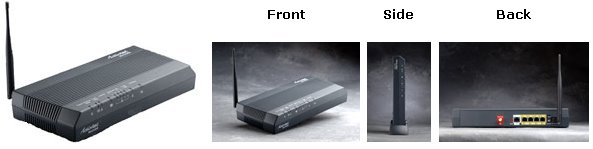
The newly launched Broadband Home Router will be the centerpiece of verizon customer’s home network. The new router – designed and built to Verizon’s specifications and supplied by Actiontec Electronics of Sunnyvale, Calif. – is the basis of Verizon’s digital home architecture, and is capable of providing connectivity to the FiOS network at speeds of up to100 megabits per second (Mbps). It leverages existing in-home wiring for broadband data and video signals and delivers easy, high-quality, more reliable home-networking solutions to provide connectivity to the increasing number of connected consumer devices. The new broadband home router also supports remote management that uses new industry standards known as TR-069, enabling Verizon to perform troubleshooting without having to dispatch a technician. Customers who purchase Verizon’s FiOS Internet Service products, as well as those who order FiOS TV, will automatically receive the new router as part of the installation.

Known as Actiontec’s model MI-424-WR, the new broadband home router was built to Verizon’ specifications and allows Verizon to accomplish its goal of providing, high-quality managed broadband services over a unified home network to all connected devices. This any-to-any device capability allows transmission of FiOS data and video signals between the Internet and consumer devices in any room, enabling a true digital home experience.

The optical network terminal (ONT) where Verizon’s fiber terminates at the customer’s home will soon be upgraded with technology similar to the Broadband Home Router. This will minimize installation disruption for Verizon customers because existing in-home coaxial wiring can be used instead of the Ethernet cable that the company has been installing between the ONT and the router. This results in savings for Verizon through shorter installation times, increased productivity and reduced installation expenses.

In addition, the new router’s wireless capability allows the customer to connect with other wireless card-equipped computers within the home. The Actiontec router’s 100 Mbps capability allows Verizon to continue to provide higher data speeds to the customer, as they become available in the future, without having to install a new router or other equipment in the customer’s home. Verizon’s FTTP network is capable of providing such speeds. In addition, the new router allows Verizon to remotely assist customers in configuring it to meet specific needs within the home. Verizon also provides customers a business-class Internet firewall on the router.


Cost

Because most homes already have coaxial cable installed in several rooms, Verizon can significantly reduce its FiOS installation costs by using existing cabling to connect home computers to its broadband service. Today, Verizon installs Category 5 cabling for customers who have signed up for a year of broadband service free of charge. Customers choosing a month-to-month plan, must pay $69.99 for the installation. This was in addition to the $1,400 per home the company spent digging up neighborhood streets and stringing fiber on telephone poles. Verizon hopes to reduce these costs significantly in 2006. Specifically, it plans to cut the cost of laying new fiber in neighborhoods to $890 per home and reduce the cost of home installation to $715 per home.In late February, Verizon estimated its costs nearly $1,000 to bring fiber near a home. The cost to bring fiber into a home is falling, but haven't yet reached their target cost of $717 per installation. Long installs are a potential money pit for Verizon and a major hassle for customers, who in most cases have to take an entire day off to be there. On an average it takes 6 hours to install FiOS TV. Normally there are five to six followup calls just to make sure everything is working well.


Pricing

The reasons consumers give for switching to Verizon's fiber-optic service vary. Some are turned off by the steady rate increases of cable companies. Some lust for the picture quality and speed of FiOS. Some merely like the convenience of having all their telecommunications services, including wireless, on one bill.

For example In Woburn, Verizon is competing against two cable companies, Comcast and RCN, and two satellite companies, DirecTV and Dish TV. Verizon's FiOS TV and Internet monthly services cost $40 apiece or $70 as a bundle, plus $4 to $13 for a set-top box. Phone plans vary, with unlimited domestic calling costing anywhere from $25 to $40, depending on the features and type of service. Comparable packages at competitors cost more, but apples-to-apples comparisons are difficult. Both Comcast and RCN are currently offering three-way bundles that cost roughly $100, although both bundles have fewer TV channels than Verizon. Comcast's bundle price expires after 12 months and then rises to $121. Moreover according to Verizon, their fiber will be capable of carrying far more content at faster speeds than cable. The top Internet speed now is 30 megabits per second, but speeds of 100 megabits per second may be possible as early as next year.

Comcast, after completing a major overhaul of its network in 2003, has ratcheted up the speeds of its Internet service, beefed up its video-on-demand offerings to 7,000 programs, and cut customer complaints with its four call centers in Massachusetts. The cable giant is also preparing to take another bite out of Verizon later this year by launching a wireless phone service that will run on the Sprint network.

Friday, June 30, 2006

Cable's Wideband response against IPTV

Cable operators are concerned about telco fiber and IPTV deployments, but they also understand that these formidable competitors can’t move faster than their backhoes. So while the telcos dig and deploy new networks, MSOs are readying competitive responses.

At the top of the list is “wideband” technology that will boost DOCSIS cable modem speeds to more than 100 Mbit/s, fast enough to compete with any near-term telco fiber offering.

Today’s DOCSIS 1.0, 1.1, and 2.0 cable modem networks are only able to support data transmissions within a single downstream 6 MHz radio frequency (RF) channel, limiting maximum throughput to 38 Mbit/s per modem. To hike data rates, CableLabs is cooking up a new standard – DOCSIS 3.0 – that will enable a cable modem to simultaneously tune into multiple 6 MHz channels through packet bonding techniques. The approach creates a wideband channel that can support well over 100 Mbit/s downstream, although the bandwidth is shared among many cable modem users.

While wideband is a powerful weapon in cable’s arsenal, there’s a catch. The DOCSIS 3.0 specification isn't done. In fact, it's not even close. And once it is finished, there will be a long wait for cable modem termination systems (CMTSs) that qualify for DOCSIS 3.0 specification compliance. It is anticipated that it may take two to two-and-a-half years to get a qualified CMTS in the markets

That’s not good news for cable operators with AT&T or Verizon breathing down their necks in the early telco TV markets. The same is true for MSOs in Europe and Asia that are already hip-deep in high-stakes bandwidth battles. To speed up wideband availability, CableLabs recently floated the idea of an interim DOCSIS 2.0b initiative, but that has been nixed due to concerns that it would further delay DOCSIS 3.0 availability.

Hedging their bets, MSOs have been pressing the top DOCSIS CMTS and customer premises equipment (CPE) suppliers – Cisco Systems, Motorola and ARRIS – to produce pre-standard wideband gear for near-term deployment. Each of these three players now has pre-DOCSIS 3.0 wideband modems and CMTS solutions in field trials and plans general availability within 2006.

ARRIS and Motorola are following similar paths by enabling wideband capabilities through software upgrades to their existing CMTS cards and chassis. The benefit of this approach is that it allows cable operators to roll out wideband using existing CMTS hardware. Plus, the approach enables MSOs to create wideband links logically across existing channels already in use for DOCSIS 1.0, 1.1 and 2.0 services. This way, they can avoid allocating precious new spectrum for wideband services. Cisco, on the other hand, is implementing wideband using a modular CMTS (M-CMTS) configuration. ARRIS and Motorola say they have M-CMTS solutions on their roadmaps as well. They're also developing DOCSIS CMTS cards with decoupled upstream and downstream ports that will alleviate potential wideband efficiencies via traditional CMTS designs.

Motorola’s first announced wideband customer is StarHub. The Singapore MSO is now launching a wideband trial and plans to begin offering a 100-Mbit/s Internet service commercially by the end of 2006. Near-term availability of wideband gear is good news for cable operators, even if that only includes pre-DOCSIS 3.0 products. The trade-off is that in pre-standard configurations, cable operators must buy the modems and CMTS products from the same supplier to ensure compatibility. Initial wideband modems will also cost four to five times as much as today’s DOCSIS 2.0 models.

As a result, tech vendors expect that sales of pre-standard products will be modest at best. Until DOCSIS 3.0 is ready for prime time, MSOs are likely to deploy wideband only in residential markets facing intense competitive pressure, as well as for targeted business services.

Wednesday, June 28, 2006

AT&T : Uverse IPTV


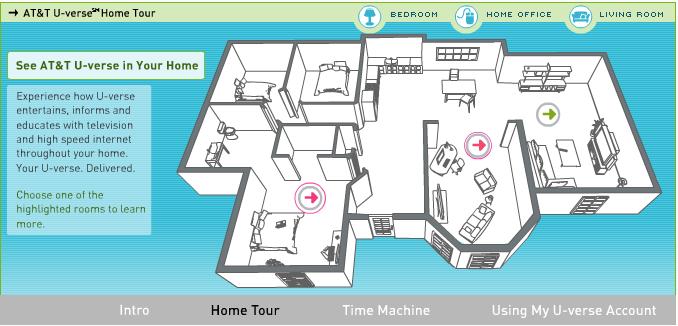
U-verse's Vitual Tour


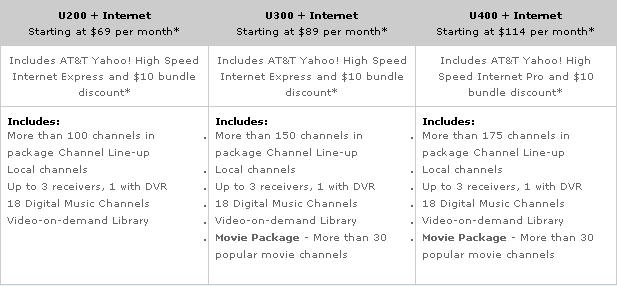
Price Comparison amonst different offerringd


AT&T has at last launched its internet-based TV service i.e. U-verse video and high-speed Internet service to about 5,000 homes in San Antonio, Texas. Texas was also chosen by Verizon for its baby steps into IPTV, called Fios TV. A comprehensive roll out won't now take place until next year. The launch follows a field trial in San Antonio, AT&T's headquarters, beginning last December. AT&T is planning to roll out service in Houston this summer as well. AT&T will be launchin U-verse in 15 to 20 markets this year where it had built out its Project Lightspeed fiber-to-the-node network. Project Lightspeed is the SBC initiative to expand its fiber-optics network deeper into neighborhoods. That delivers AT&T's U-verse TV, voice and high-speed Internet access services.

Price: Current price declared by AT&T for its U-verse service might not have the cable competition panicking about their margins just yet. The entry-level U-verse package starts at $69, and the premium service costs $114 a month. That's comparable to cable, but U-verse does, however, include internet options up to 6Mbits/s.
AT&T also is offering family-oriented bundles starting at $54 a month, as well as a premium Spanish-language package for an extra $10 per month after a promotional three-month discount. The introductory installation fee is $20, down from $95. The company is offering qualified customers three months of free "live TV"

Features:
The services come with three TV receivers per home, including one with a digital video recorder, and a wireless Internet router. DVRs allow viewers to pause, rewind, replay and record live TV. TVs become IP-enabled via the IPTV receivers and can be used to display digital photos and other content. AT&T's STBs will run Microsoft IP-TV software and allow users a variety of interactive functions like video recording and video on demand. U-verse includes 200 channels of IPTV, Spanish-language programming, video-on-demand, and an interactive program guide. Features exclusive to IPTV include faster channel-changes, a mosaic approach to picture-in-picture displays, and content searches via keywords such as actor names. The service is launching with DVR capabilities on one receiver but will add whole-home DVR capabilities and High Definition TV later. The U-verse service includes IPTV and high-speed Internet access. AT&T is offering access at 1.5 Megabits per second; 3Mb/s and 6 Mb/s.

Fibre Strategy:
SBC's Project Lightspeed is using VDSL-2, to reach the overwhelming majority of their homes. They deliver fiber to the node, but twisted pair copper to the home. SBC uses Alcatel gear for the fiber backbone. It consists of IP routers, the 7750, the Ethernet switches, the 7450, the remote DSLAM, the 7330. Microsoft's IPTV solution is used for the settop box. AT&T has been building a $4 billion fiber-optic network to offer television, Internet and telephone service over phone wires. The fiber-to-the-node initiative will catapault SBC into a 13-state market for voice, video and data services and is the world's largest IP-TV rollout. Alcatel is primary supplier for Project Lightspeed infrastructure in a $1.7 billion deal. Within three years, about 18 million SBC households will have access to this network.

SBC is Using the release 1.1 of Microsoft’s IPTV middleware for IPTV launch offers four standard-definition streams. It also will support three standard-definition and one high-definition video stream, and will offer more than 200 channels. It further will include double the number of VoD options available during the controlled launch and provide the same high-speed Internet access. IMS-based VoIP will become part of the service starting in December. SBC has picked IP-TV settops from Scientific-Atlanta and Motorola for the telco's planned IP-TV system. Financial terms of the two contracts were not disclosed. The contracts give equal market opportunity to both vendors and continue through the end of 2008. AT&T's Homezone subscribers will use their integrated set-top box with AT&T Yahoo broadband to access video programs and movies, as well as tap into television programming through the AT&T-DISH Network satellite service. AT&T aims to use Akimbo as another tool to expand its IPTV offerings, which include phone, data and voice services designed to compete with those offered by cable companies. company is also on the cusp of announcing an intelligent NID (iNID) for the deployment. That device would sit outside the home to terminate video and data traffic, and a residential gateway with 802.11n would sit inside the house. AT&T is using MoCA technology for in-home networking today, but HPNAv3 over twisted pair and 802.11n are where it’s planning to go on the long term, as HPNAv3 works well both for single-family homes as well as for multidwelling units, in which a cable company may own the in-building coax. HPNAv3 is integrated into the set-top boxes AT&T is using. IPTV i.e. U-verse has gone pretty smoothly for AT&T as it moves through its controlled tests and on to its commercial launch, one of the challenges was integrating the Microsoft software and other parts of the Lightspeed solution with two different iterations of set-top boxes. For the controlled launch, AT&T was using Tatung set-top boxes, but the commercial services will use Motorola Inc. and Scientific-Atlanta set-top boxes, which are based on STMicroelectronics and Sigma Design Inc. chips, respectively.

In addition to the Lightspeed effort, AT&T this month or next will commercially launch throughout its DSL footprint a new hybrid DBS/DSL service called HomeZone, which uses a 2Wire box to deliver services within the consumer’s home. HomeZone will have a similar user interface look and feel to what’s being used for Lightspeed with very comparable video quality. It will include the same channel options available today through EchoStar’s DISH, which is providing the DBS component of the service. And it will offer pay-per-view and VoD options, including a broad slate of selections AT&T will provide in collaboration with Akimbo. VoIP is not a feature of the HomeZone bundle.

Further posts will be augmented with AT&T's pricing and component strategy